


Youngsters Dig Deep to Help Create Micro Forest in Clitheroe
Primary school children swapped studying for spades as they helped create a third Miyawaki micro forest in Ribble Valley.
Pupils from Edisford Primary School dug deep to help plant hundreds of saplings at Henthorn Park, Clitheroe.
The joint project between Ribble Valley Borough Council and Lancashire County Council will transform a section of the park into a dense forest of trees that will attract wildlife and sustain a wide range of birds and insects.
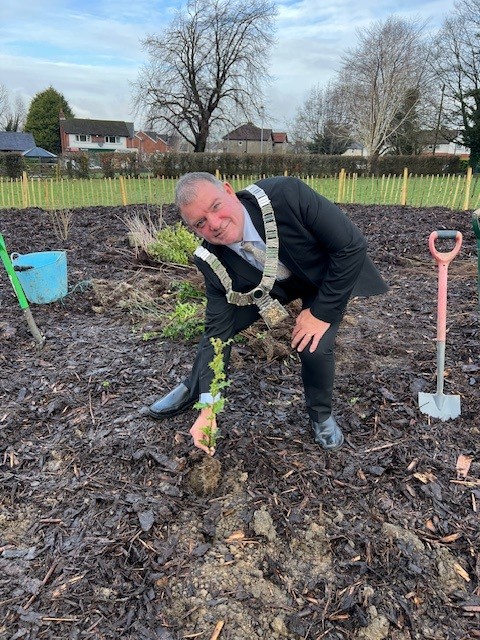
The children were joined by the Mayor of Ribble Valley, Councillor Simon O’Rourke, who said:
“It was lovely to see the children getting their hands dirty and joining in with the planting. They didn’t seem to mind the mud and they obviously enjoyed being out of the classroom and helping to do their bit to improve the local environment.”
County Councillor Joshua Roberts, cabinet member for Rural Affairs, Environment and Communities, said:
"Our micro-forest scheme is on track to have planted more than 48,000 trees across 42 micro-forests in the county before the end of the current planting season.
"These new forests are being brought to life thanks to help from community groups, volunteers and schoolchildren who have planted thousands of trees, bringing a real sense of civic pride to local communities"
The area chosen for the forest is waterlogged and the trees will help dry the land, as well as improve air quality.
Other Miyawaki micro forests have been created in Ribble Valley at Edisford Road (in March 2024), and John Smith’s playing field, Longridge (Feb 2025),
Japanese botanist Dr Akira Miyawaki developed the tree planting technique, which involves enhancing the soil and planting trees closer together, resulting in faster growth than traditional techniques. This sped-up process allows important wildlife habitats to form much more quickly than they would do normally, giving them almost-instant resilience to drought, flood, and vandalism.
Unlike conventional tree planting projects, micro forests are planted up at super high density. A tennis court size plot will be planted with approximately 850 very young trees, known as whips.
To enable the trees to establish themselves in their first spring in the micro forest, the ground is specially prepared ahead of planting to create perfect growing conditions for young trees – warm, well drained, aerated soil which Is rich in nutrients and full of fungi. Growing in these conditions allows the young trees to concentrate more of their energies on vertical growth and less on simply staying alive in a stressed environment. The result is a low failure rate, rapid growth, and healthier trees.
The planting scheme was funded through the Tree Council Tree Outside Woodland Fund (TOW) and Lancashire County Council (LCC).